
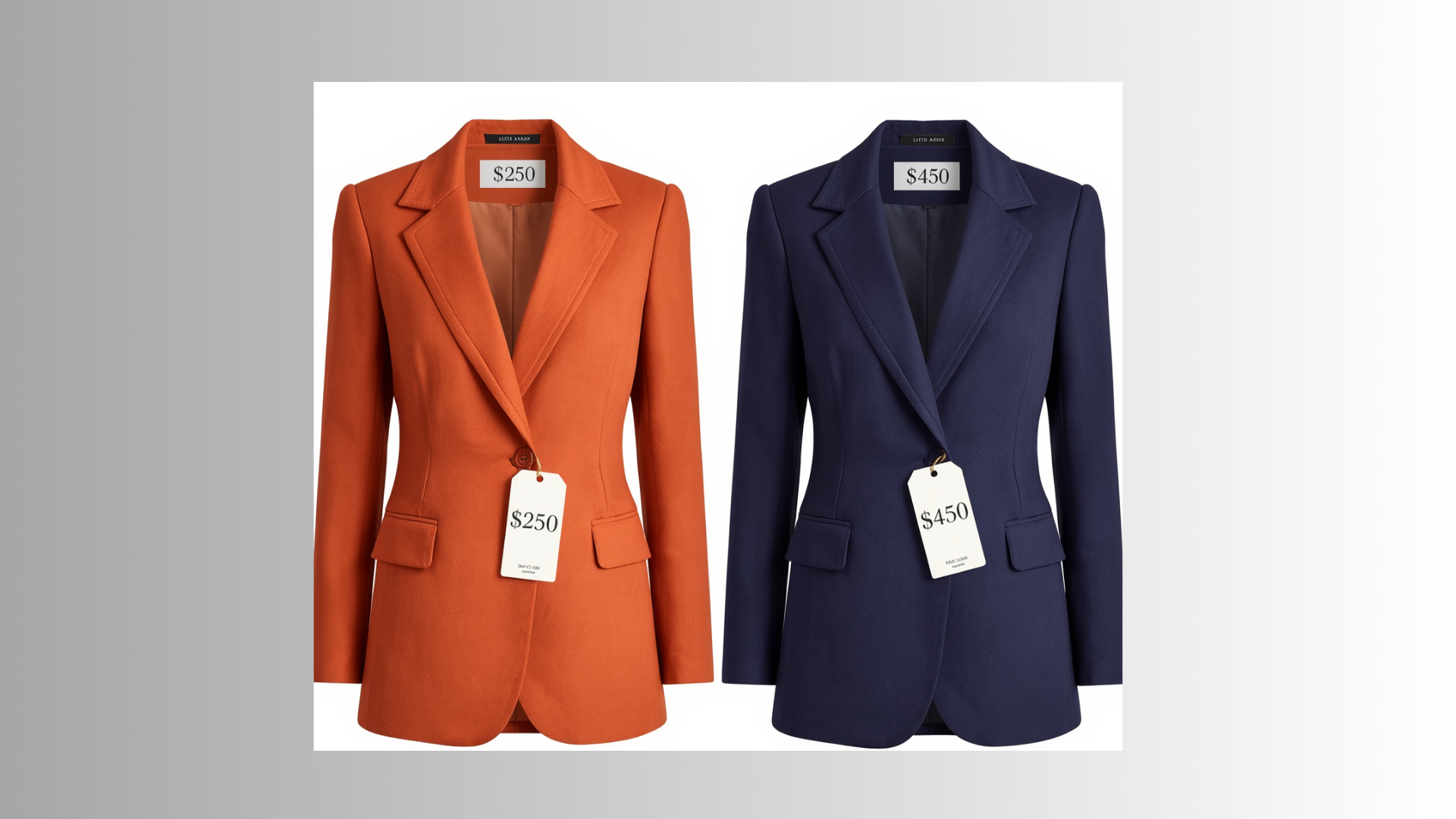
Sarah had been staring at a $250 jacket for 5 minutes, unable to decide whether to buy it.
$250 - In her budget, but not quite comfortable. Then she glanced at another jacket. Same style, slightly heavier fabric, but priced at $450. She bought the first jacket within the next minute.
Why was Sarah able to make up her mind quickly after seeing the second jacket? Nothing changed - not its price, not quality, not her bank account. What changed was her perception of what $250 meant when compared to $450.
This is Price Anchoring, a powerful tool in pricing psychology. What most merchants do not fully understand about price perception is that customers rarely know a product’s true value. They only know what it’s worth relative to something else.
Pricing Psychology and Price Anchoring
Price anchoring is a cognitive bias in which the first number a person sees shapes how they evaluate subsequent numbers.
In 1974, psychologists Daniel Kahneman and Amos Tversky conducted an experiment. They spun a wheel in front of the participants, then asked them the percentage of African countries in the United Nations. The wheel was rigged to land either 10 or 65. The people who saw 65 guessed significantly higher than those who saw 10. [1]
The wheel was random and had nothing to do with the question. Its sole purpose was to show how the first number the participants encountered hijacked their judgment.
Kahneman and Tversky called it the anchoring effect: the well-documented cognitive bias where the first piece of numerical information we encounter sets an invisible reference point that shapes every evaluation that follows. We like to think that we are reasoning from first principles when we assess the price of a product. But we are not. We are reasoning from whatever number we saw first.
For e-commerce merchants, this has an implication: your customers land on your product page without a clue what your product should cost. They have no internal meter for whether $89 is fair for a serum or absurd for a supplement. What they have is a search for context - a reference point their brain can anchor to before it can form any judgment at all.
If you don’t provide any anchor, they will find one themselves - a competitor’s price, the last product they bought, what price their friend bought the product for, or a number they half remember from Google Search. You have ceded control of the most important variable in their purchasing decision.
Price anchoring shouldn’t be looked at as manipulation. It is assisting the customer’s brain to get the context it is already hunting for.
Four Price Anchoring Techniques that increase E-Commerce Conversions
Deploying price anchoring techniques on a product page, a pricing table, or a cart is an art. There are four patterns that consistently appear across high-converting e-commerce stores - each exploiting a slightly different dimension of how customers process price.
1. The Strikethrough: Original vs Sale Price
This is the oldest trick in retail and still works because the psychology behind it is airtight. When a customer sees a product listed at $120 $79, their brain doesn't process $79 in isolation. It processes $79 relative to $120. The original price becomes the anchor, and the sale price becomes the deal. The customer isn’t asking “ Is $79 is a fair price? ” Instead, they are asking “ Is $41 off a good saving? ”, which is an easier question to answer and almost always results in a yes.
If your store runs perpetual sales, where the "original" price has never been the selling price, you are not anchoring anymore. You are training customers to wait for discounts and quietly eroding trust in your pricing. A brand that is always on sale has no anchor at all. The strikethrough works best when used sparingly - for seasonal promotions, clearance events, or first-time purchase offers.
2. Tiered pricing: The Goldilocks Effect
In movie theaters, small and large popcorns exist only to make the medium popcorn look reasonable to the customer. The medium has not been designed to be the best value size, but when compared to the price-to-volume ratio of the other two sizes, the medium popcorn looks like the obvious choice.
This is tiered pricing, which is arguably the most effective application of anchor pricing used in e-commerce and Saas pricing. The bottom tier signals compromise, and the top tier signals excess. The middle tier signals just the right amount - “The Goldilocks Zone”. Behavioral economists call this the compromise effect. This means that merchants can push customers to buy a certain product simply by pricing the products that sit above and below it in a relatively unappealing way.
Merchants need to price the top tier in a way that genuinely feels premium, not just expensive. The bottom tier shouldn't be so cheap that it feels like a trap. If the gap between the mid and top tiers feels random, the top tier fails as an anchor, and customers start to distrust the whole ladder. The goal is a pricing structure where the middle option feels like the conclusion a reasonable person naturally reaches.
3. Bundle Anchoring
Bundles are popular in e-commerce because they make savings visible to customers by showing how much it would cost to buy each item individually and then showing how much it would cost to buy the same items clubbed together in a bundle. The anchor in this case is the sum of the products’ prices, and the deal is the bundle, which is always cheaper.
Let’s look at the example of a store with 3 products.
Cleanser - $28
Toner - $32
Serum - $54
Bought Separately - $114
Bundle price: $89
At first glance, $89 for all three products looks expensive. However, when you compare it to $114 for the three products when purchased separately, it looks reasonable. The customer’s mental frame shifts from absolute cost to relative saving when comparing $89 with $114.
Bundle anchoring also solves product discovery problem. Sometimes, customers are not aware of all the products a store has. The bundle acts as a curated recommendation, and the anchor pricing incentivizes a customer to buy a bundle over buying the products individually, provided the bundle is properly designed. If the “if bought separately” price is only marginally higher than the bundle, the anchor barely registers. In order to move the needle, the perceived saving needs to feel meaningful: typically 15-25%.
4. Decoy Pricing: The Asymmetric Option
Let’s understand Decoy Pricing using The Economist magazine’s subscription options, analyzed by the famous behavioral economist Dan Ariely [1]. He tested how an asymmetrically dominated option influences choices between digital-only ($59) and digital+print ($125) plans. Two hundred students participated in this study across two separate experiments.
The first group of 100 students faced the following 2 options: Digital-only at $59 and Digital+Print at $125. In this group, 68 students chose digital-only, and 32 chose digital+print.
The second group of 100 students faced these 3 options: Digital-only at $59, Print-only at $125, and Digital+print at $125. The Print-only option was introduced as a decoy in this case to affect the students’ choices. 16 students chose digital-only, no student chose print-only, and 84 students chose digital+print. Adding the decoy boosted the preference for the more profitable digital+print option by about 30%, showing how context shifts decisions predictably.
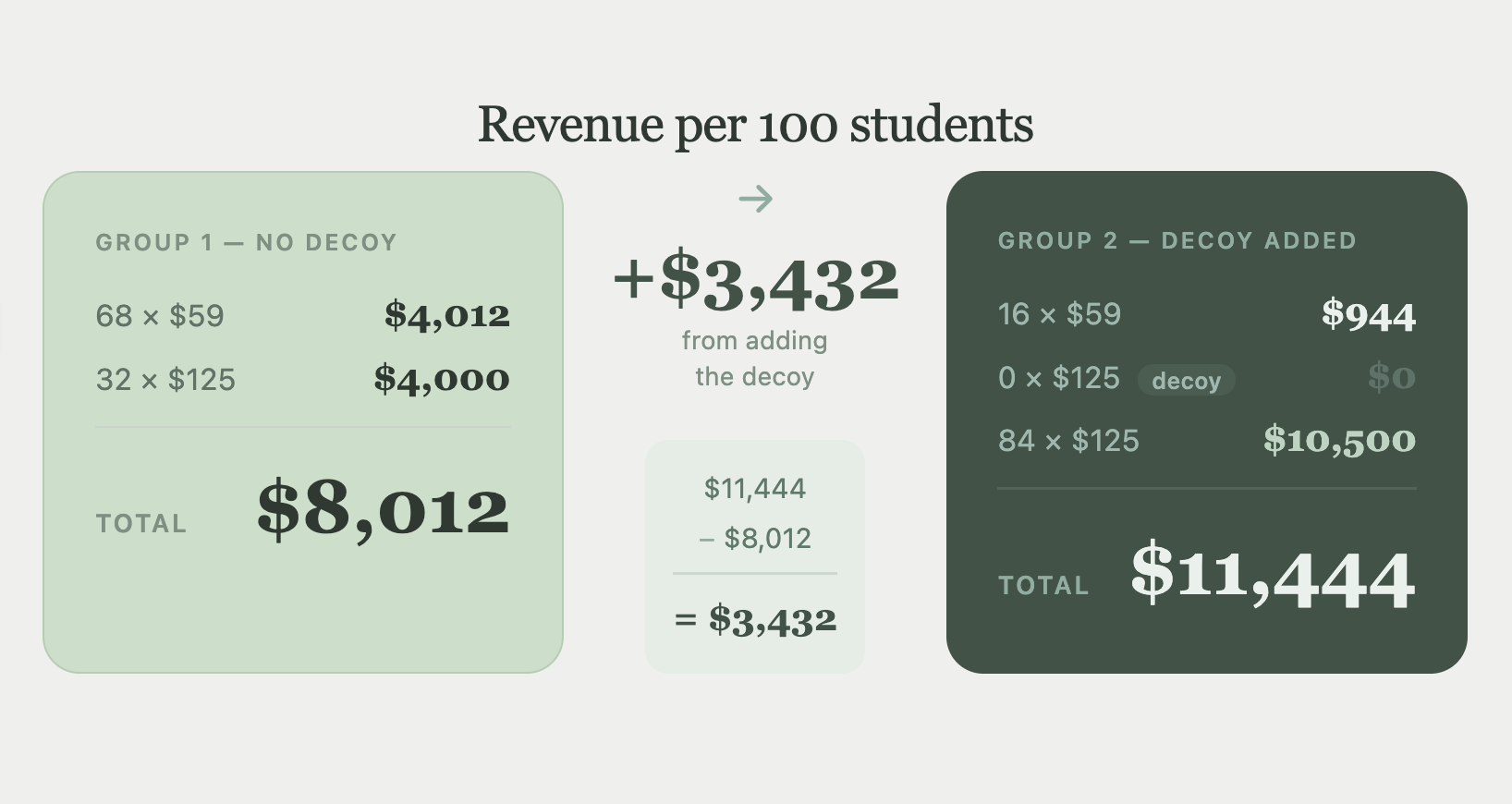
The trick in decoy pricing is to construct an option that is clearly inferior on a value-per-dollar basis compared to your preferred choice, thus making that choice obvious for a rational buyer.
However, the best decoys are products you would genuinely sell - they just happen to be asymmetrically dominated by the option you most want customers to choose.
These four techniques are not mutually exclusive. They can all be used in tandem to persuade a customer to buy a certain product. For example, a product page might use a tiered structure to guide tier selection, strikethrough on the anchor price, and a bundle to increase average order value - all simultaneously. The merchants who see the biggest lift are those who stop thinking about each technique in isolation and start thinking about the anchoring architecture of their entire store.
Each of the four techniques discussed above has problems with its execution. In addition to them, there is a separate class of mistakes of a structural nature that can’t be fixed by a good per-page execution. These mistakes are also hard to spot because they occur at the store level and not the product level.
Top 3 Price Anchoring mistakes
The price anchoring techniques discussed above are straightforward to implement on a single page. The mistakes discussed in this section are difficult to catch because they don't occur on a single page - they show up on your conversion data weeks later. They operate on the store level, which means fixing the individual page won't fix the problem. Let's take a look at these mistakes.
1. Anchoring Logic is inconsistent across the Catalog
A product catalog where anchoring is applied randomly - some products with tiers, some with strikethroughs, and some with nothing- can be problematic because it sends the message of arbitrariness in pricing. This makes the customer wonder what the actual price is. They may lose confidence in you, and there is a high chance you will lose the customer.
It is therefore important that while anchoring products, you remain consistent across your homepage, all product pages, bundle offers, and cart. Merchants who see the most durable conversions are those who have designed their anchoring architecture holistically - not those who applied this technique to a couple of their best-selling SKUs.
2. Anchors that are designed for desktop break on Mobile
A tiered pricing table works well on desktops because all three tiers are visible simultaneously, making comparisons easier at a glance. On the mobile, this same table collapses into a vertical scroll. By the time a customer reaches the middle tier, they have lost the top-tier that was supposed to anchor it, and the comparison never happens. The same problem occurs in strikethroughs. Most merchants design an anchor for a 1440-pixel screen and don’t audit what survives on a 390-pixel screen. Since mobile accounts for the majority of e-commerce traffic, this issue can be a major conversion leak.
3. Tightening regulations around Price Anchoring
Several jurisdictions, including the EU, UK, and a growing number of US states, are actively tightening regulations around reference pricing. The Omnibus Directive of the EU requires that any “original price” written next to a sale price must reflect the lowest price charged in the preceding 30 days. Anchor prices that were never real selling prices are increasingly being treated as a form of consumer deception.
Apart from the risk of regulatory authorities coming after you, there is also a risk of completely losing your customers' trust if they sense a fabricated anchor.
We can see that anchoring can fail at both the technique and system levels. Thus, anchoring should be treated as infrastructure and not a collection of isolated tricks.
A Quick Audit of Price Anchors
Most anchoring problems are invisible but have an opportunity cost. A fabricated reference price, a pricing table that collapses on mobile, an outdated anchor designed months ago - none of these announce themselves. The fastest way to find them is to run every product page through the following five questions:
As a merchant, you should run every key product page through these 5 questions:
- Is there an anchor?
- Is the anchor believable?
- Does the anchor survive on the mobile?
- Is the anchor consistent with the rest of the catalog?
- When did you last review it? If the answer is when you launched it, it means the anchor is outdated.
If the answer is 'no' for more than two of these questions, then you are not optimizing your product page and you should be reviewing your pricing strategy.
Conclusion
Let’s go back to our jacket shopper Sarah.
She didn't buy the jacket because it went on sale, or because its quality improved, or because her budget grew. She bought it because a price anchor was introduced to her. So, the frame around the jacket's price changed, which was enough for her to get over her initial hesitation. The jacket was always worth $250. Sarah just needed to see another jacket for $450 to believe it.
The price is what a product costs. The frame is what it feels like. Merchants who understand this compete on pricing psychology rather than the price itself.
References
1. Tversky, A. & Kahneman, D. (1974). Judgment under Uncertainty: Heuristics and Biases. Science 185(4157), pp. 1124-1131.
2. Ariely D (2010) Predictably irrational. Harper Perennial Edition, New York.